Overview
About this Manual
The purpose of this document is to:
- Establish construction program guidelines to maintain compliance with Title 23 Code of Federal Regulations (CFR) and state regulations to implement and execute the provisions of Federal law relating to the administration of Federal aid for highways.
- Establish and maintain consistency in the statewide construction program.
- Guide Construction Field Crews and the Construction Division in administering the contract and ensuring the quality of construction.
- Communicate the policies of the Construction Division to meet the requirements of Transportation Policy (TP) 1-8-1(Construction Division Policy).
- Outlines the interaction of key stakeholders throughout the contract life-cycle.
- Serve as a training resource in order to provide statewide consistency in all aspects of the construction process.
This manual is divided into the following chapters:
- Introduction
- Contract Administration
- Surveying
- Sampling and Testing
- Inspection
This manual should be easily read and understood by anyone with a fundamental understanding of NDOT's construction process. In conjunction with related documentation and supplemental training, this manual will serve as a framework for administering NDOT contracts.
The Construction Manual does not address every phase, process or event throughout the contract/project lifecycle in detail, nor will it replace good engineering judgment. References to documents and/or related resources are provided throughout this manual where necessary or applicable.
Conventions Used in This Manual
References in this manual include the following:
- “The Department”: the Nevada Department of Transportation (NDOT).
- “Project”: The lifecycle of an NDOT project up until it is advertised.
- “Contract”: The lifecycle of an NDOT project upon advertisement.
- “Standard Specifications”: NDOT’s Standard Specifications for Road and Bridge Construction. (This includes “Special Provisions”, unless otherwise stated.)
- “Standard Plans”: NDOT’s Standard Plans for Road and Bridge Construction.
- “Project plans”: Plans, as defined in Subsection 101.03, “(Terms and Conditions) Definitions”, of the Standard Specifications, specific to the contract/project.
- “Special Provisions”: Specifications specific to the contract/project.
- “Contract documents”: All documents identified under “Contract” in Subsection 101.03, “(Terms and Conditions) Definitions”, of the Standard Specifications.
- "AWP": AASHTOWare Project Construction & Materials™ electronic documentation web-based software
The order of precedence of contract documents is:
- Supplemental Notices
- Special Provisions
- Project Plans
- Standard Specifications
- Standard Plans
When discrepancies and/or contradictions exist within the above referenced documents occur, always follow the order of precedence to determine the governing documents. Guidelines when working with Standard Specifications, Standard Plans, Project Plans and/or Special Provisions include:
- Always verify changes to the Standard Plans and Standard Specifications by referencing the Special Provisions, Project Plans and Supplemental Notices.
- Changes to Standard Specifications in between published editions are made as Pull Sheets. When a Pull Sheet is implemented, it is included in a project’s Special Provisions. (This incorporation of change in contract documents is a reason why Special Provisions take precedence over Standard Specifications.)
- Changes to Standard Plans are made as Special Details. When Special Details are implemented, they will be included in the Project Plans. (This incorporation of change in contract documents is a reason why Project Plans take precedence over Standard Plans.)
- Changes to contract documents after a project is advertised but before the bid is opened are provided in a Supplemental Notice.
Updates, Revisions to This Manual
The Construction Division is responsible for maintaining an updated Construction Manual. The Chief Construction Engineer will revise and/or issue updates as needed. Users can request a revision to the guide in writing to the Construction Division at ndotconstruction@dot.nv.gov. The Construction Division will review the request and take appropriate action. Between revisions/updates, the Chief Construction Engineer may issue interim Construction Division policy memorandums that would be incorporated into the next revision.
The Nevada Division of the Federal Highway Administration (FHWA) approves the Construction Manual and any updates/revisions in accordance with Title 23 CFR.
Distribution of This Manual
The latest approved version of the Construction Manual is posted on the NDOT Internet site [].
Statewide Construction Program
The Department administers construction contracts in accordance with Title 23 CFR regardless of whether they are federal- or state-funded to provide uniform guidance for contract administration to all the construction crews.
In Nevada, transportation project funding can come from several sources:
- State and federal governments
- City and county governments
- Regional Transportation Commissions, such as in Clark County, Washoe County and Carson City
- Private entities
If a single project has multiple funding sources, a specific funding source may pay for only a portion of the work to be completed. For example, a roadway project may start in the City of Las Vegas and then cross the City boundary into the City of North Las Vegas. If NDOT and the FHWA participate in funding the project, each city would provide funds for work only within their city. NDOT monitors and documents the cost of work completed in specific portions of the project to ensure that each entity funds only its respective part of the project cost.
Several Divisions deliver the Department’s statewide construction program. The success of a construction project requires a clear understanding of each individual’s role and responsibilities. The Construction Crews, District Administration, Construction Division, FHWA and all participating Divisions have specific responsibilities in assuring that construction projects are completed successfully.
Organization
Nevada law establishes the general structure of NDOT (Nevada Revised Statutes, NRS, Chapter 408). The seven-member State Transportation Board, chaired by the Governor, approves Nevada’s transportation program. Elected officials and public appointees comprise the Board. The elected officials are the Governor, Lieutenant Governor and State Controller. The Governor appoints four public members: two from District 1, and one each from District 2 and District 3.
The Transportation Board appoints a Director to administer the state’s transportation program. The Director appoints three Deputy Directors and four Assistant Directors that oversee the Department’s Divisions and Districts. (See : NDOT Organization Chart.) NDOT's headquarters is located in Carson City, and the three main District offices are located in Las Vegas, Reno and Elko.
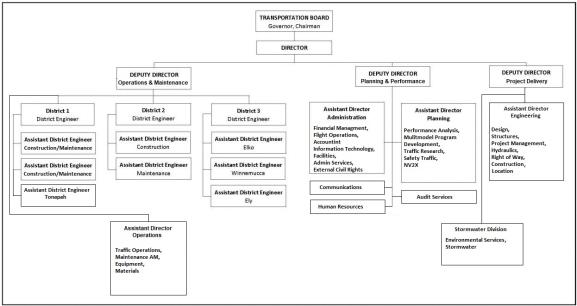
District Administration, Construction Field Crews
The Department has three Districts, each with a District engineer and assistant engineers. The Districts are responsible for supervising all state transportation activities within their local areas.
Construction crews for each District are administered by the District Engineer and Assistant District Engineer, Construction. A construction crew typically consists of a Resident Engineer, assistant Resident Engineer, Professional Engineer, inspectors, materials testers, and a survey crew chief. The Resident Engineer is NDOT’s field representative on construction projects. The Resident Engineer administers the contract, which includes monitoring and documenting the Contractor’s operations. (See : Typical District Organization Chart for Construction Crews.)
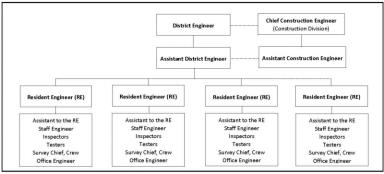
: Typical District Organization Chart for Construction Crews
Construction Division
The NDOT Director delegates various responsibilities for administering construction contracts to the Assistant Director of Operations. In turn, the Assistant Director of Operations delegates many of these responsibilities to the Chief Construction Engineer. To execute NDOT’s construction program, the Construction Division is organized as shown in : Construction Division Organization Chart.
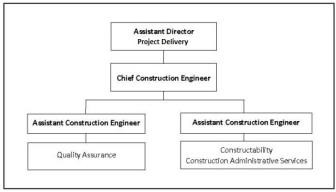
: Construction Division Organization Chart
Roles and Responsibilities
District Administration
Three Districts implement NDOT’s statewide construction program. : District and Sub-District Boundaries depicts the boundaries of each District and sub-District.
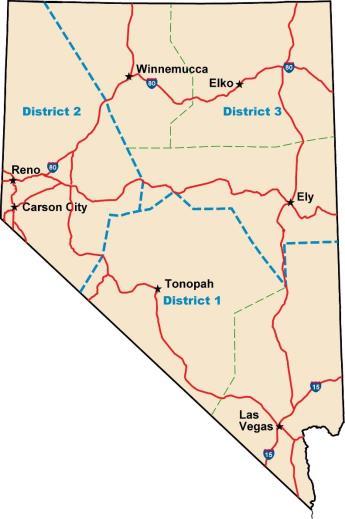
: District and Sub-District Boundaries
District Engineer
The District Engineer directs the operations within the boundaries of a District, including both construction and maintenance operations through their respective Assistant District Engineer(s). The District Engineers evaluate, process and recommend approval of change orders, and they resolve disputes and claims within the limits of their authority. In cases that exceed allowable authority, the District Engineer will provide recommendations on project issues to the Chief Construction Engineer.
The District Engineer is responsible for informing the Construction Division’s Chief Construction Engineer on the status of work. Common status issues include problems or issues encountered on projects/contracts, decisions that have been made and recommendations for improvements in construction practices. The District Engineer is also responsible for conforming to Department and Construction Division policies, procedures and/or directives, and for coordinating construction activities with other District operations. The District Engineer also manages the contract’s final inspection and recommends final acceptance to the Director
Because each District is unique in topography, climate, population and industry, Districts must be involved through the life of a project/contract. The District Engineer’s direction is crucial in mitigating the impacts, such as traffic delay and business disruption, that the project may have on the local communities within the District.
Assistant District Engineer
Assistant District Engineers support the District Engineer in successfully delivering the NDOT statewide construction program. Depending on the District, an Assistant District Engineer can be assigned construction and/or maintenance operations. For construction activities, Assistant District Engineers supervise/manage the Resident Engineers.
Assistant District Engineers work in conjunction with the Construction Division’s Assistant Construction Engineers in the execution of the construction program to ensure compliance with state and federal regulations along with NDOT policies and procedures through the life of the project/contract.
Construction Field Crews
A typical field crew consists of:
1 – Resident Engineer
1 – Assistant to the Resident Engineer
1 – Staff Engineer
1 – Survey crew chief
8 – Inspectors, testers, and surveyor crew
1 – Office Manager
Because a Construction Crew is assigned multiple contracts, proper allocation and management of staff resources across contracts is critical in order to maintain consistency within each contract and to ensure sufficient contract oversight and technical expertise. Project staffing needs may require the District Engineer, in consultation with Resident Engineers, to temporarily transfer personnel from one crew to another. If adequate resources are not available within the Department, the District Engineer may request service provider assistance (Refer to Service Provider Procurement for more information).
Resident Engineer
The Resident Engineer is responsible for the management, administration and successful completion of an NDOT construction contract, which includes monitoring and documenting the Contractor’s operations. The Resident Engineer is a direct representative of the Director and reports directly to the Assistant District Engineer.
The Director delegates authority to the Resident Engineer to administer construction contracts. As part of this authority, the Resident Engineer is the primary point of contact for the Field Crew, Contractor and service providers, and all communication is required to go through the Resident Engineer. At no time will direction be given to the Contractor and/or service provider by anyone but the Resident Engineer (or his/her designee). All site visits will be coordinated and approved by the Resident Engineer.
A contract’s successful completion depends on the Resident Engineer’s positive leadership of the Construction Crew and a professional relationship with the Contractor.
By building and maintaining trust and teamwork on the contract, the Resident Engineer creates a collaborative environment with the Contractor, NDOT field crew and other NDOT Divisions. To maintain a high level of involvement, the Resident Engineer must frequently visit the job site and review the work.
The Resident Engineer also provides leadership to the staff assigned by the District Engineer. The Resident Engineer builds a highly effective crew by emphasizing communication and learning. When the staff communicates well among themselves, sharing knowledge and experience, they can quickly and confidently address situations that arise on a contract.
As NDOT’s most visible representative on a project, the Resident Engineer frequently communicates with the public, government representatives and motorists. The Resident Engineer’s professionalism often establishes the public’s image of NDOT.
In addition to working with the Contractor and supervising the field crew, the Resident Engineer’s specific contract-related responsibilities include:
- Providing input on development of project plans and specifications.
- Assessing the compatibility of the design with site conditions.
- Administering the contract in accordance with federal regulations, the Construction Manual and established policies and procedures.
- Monitoring projects to confirm compliance with the contract documents.
- Overseeing documentation, surveying, inspection and testing.
- Ensuring proper documentation.
- Approving contractor pay estimates.
- Resolving issues and disputes with the Contractor within the Resident Engineer’s authority.
- Negotiating and preparing change orders.
- Minimizing construction impacts to the public.
- Protecting the State from harm or damage during construction of the project.
- Providing guidance and training to the field crew.
- Communicating with the District Engineer and Assistant Chief Construction Engineer on major issues that have immediate and significant public impact.
- Overseeing the implementation of traffic control and ensure the flow of traffic along with the safety of workers and the public.
- Reviewing the Contractor’s certified payrolls.
The Resident Engineer is the first level of authority in quickly resolving issues or conflicts. The Resident Engineer may consult with the District Engineer or the Construction Division for additional guidance.
Assistant to the Resident Engineer
This position assumes one or more of the roles and responsibilities of the Resident Engineer (as directed).
Staff Engineer
For crews that contain a Staff Engineer, this position assumes one or more of the roles and responsibilities of the Resident Engineer (as directed).
Survey Crew Chief
The survey crew chief, under the supervision of the Resident Engineer, is responsible for the accurate and prompt completion of all construction survey activities. The survey crew chief’s primary responsibility is to confirm that project personnel complete the survey in conformance with the plans and specifications. To perform these responsibilities, all survey equipment and instruments must be in proper condition and accurately calibrated. The survey crew chief must be knowledgeable and understand current survey practices and technologies. Additionally, the survey crew chief maintains complete and accurate survey documentation.
After construction activities are complete, notations are added to the project plans, describing all revisions that were made to the original plans. These drawings are called record drawings, or as-built plans. The survey crew chief is responsible for adding survey information to the as-built plans. If the contractor performed the survey, then the survey crew chief collects and reviews the contractor’s survey data. The Resident Engineer reviews the survey data prior to archiving the data with the project records.
Refer to Surveying, or the NDOT Construction Survey Manual, for more information.
Inspector
Under the supervision of the Resident Engineer, inspectors are authorized to inspect all work performed and materials furnished. Inspections may extend to all or any part of the work and to the preparation, fabrication or manufacture of the work materials. Inspectors are not authorized to alter or waive provisions of the plans and specifications, issue instructions contrary to the plans and specifications, or direct contractor operations. However, an inspector communicates with the contractor and other project personnel to reduce misunderstandings relating to the interpretation of the plans and specifications.
Inspectors have two important responsibilities. The first and primary responsibility is to confirm that the contractor’s work and site activities conform to the plans and specifications. The second responsibility is to document the contractor’s work.
Inspection duties include:
- Observing and documenting the contractor’s workmanship, materials and methods for conformance with the plans and specifications.
- Communicating the project requirements to the contractor’s field staff for work under construction or about to be constructed.
- Interpreting the plans and specifications.
- Documenting inspection operations in the Daily Work Report.
- Measuring work and materials for payment in accordance with the Construction Division’s .
- Observing construction operations for compliance with safety regulations, traffic control requirements and construction-related government regulations.
Refer to Inspection, or the NDOT Field Inspection Guide, for more information.
Tester
Under the supervision of the Resident Engineer, testers are authorized to inspect or test materials incorporated or to be incorporated into the work. Additionally, testers may test materials fabricated at commercial material sites or fabrication facilities.
Because test results are the deciding factor in accepting or rejecting work or material, accurate test results are important. Therefore, the tester must maintain testing equipment in good condition. When testing equipment requires repair, replacement or calibration, the tester must inform the Resident Engineer. Additionally, testing procedures will conform to NDOT test methods, and documentation will be complete and accurate.
Refer to Sampling and Testing , or the NDOT Construction Field Testing Guide, for more information.
Office Manager
The Office Manager manages the administrative activities under the supervision of the Resident Engineer. Administrative responsibilities span contract issues, as well as Department-related administrative matters. The Office Manager is the primary resource in the Resident Engineer’s office for implementing the requirements of the .
Principal responsibilities include:
- Maintaining project files, testing records, general files and documents.
- Maintaining an inventory of survey records.
- Verifying test reports for completeness and accuracy.
- Preparing Contractor pay estimates.
- Performing preliminary calculations for liquidated damages.
- Reviewing prior approvals, change orders and letters of authorization for completeness.
- Reviewing force account analysis for completeness and accuracy.
Construction Division
The NDOT Director delegates various responsibilities for administering construction contracts to the Assistant Director of Engineering. In turn, the Assistant Director of Engineering delegates many of these responsibilities to the Chief Construction Engineer.
The Construction Division, under the direction of the Chief Construction Engineer, has responsibility and authority for establishing uniform policies and procedures for the statewide construction program. In coordination with the Districts, construction field crews, FHWA and other NDOT Divisions, the Construction Division manages and administers the statewide construction program and is responsible for ensuring compliance with federal regulations for construction activities on all construction contracts.
Chief Construction Engineer
The Chief Construction Engineer manages the statewide construction program, which includes:
- Providing guidance, policies and procedures to ensure conformance with federal and state regulations.
- Assigning personnel and resources.
- Providing technical support and training.
- Establishing construction-related policies, procedures and related documentation for statewide uniformity.
- Generating and managing budgets.
- Developing construction specifications.
- Providing technical expertise to legislative and regulatory agencies.
- Resolving construction claims and disputes.
- Serving as NDOT liaison with the construction industry.
Assistant Construction Engineer
Two Assistant Construction Engineers support the Chief Construction Engineer. One Assistant Construction Engineer oversees the construction program in District 1, the southern portion of the state, and the other Assistant Construction Engineer oversees the construction program in Districts 2 and 3, the northern portion of the state.
In addition, the Assistant Construction Engineers oversee the operations of the Construction Division’s sections.
Construction Administrative Services Section
The Construction Administrative Services Section assists the crews during the construction phase by providing contract oversight, administering the electronic documentation system, process analysis/improvement, and managing service providers and the Partnering Program.
Responsibilities include:
- Ensuring statewide uniformity in construction project documentation.
- Auditing project documentation for completeness and accuracy.
- Serving as a resource to the project crew on administrative matters.
- Reviewing and processing contractor pay estimates.
- Reviewing and processing change orders, letters of authorization and force account documentation.
- Reviewing and processing requests for stockpile payment.
- Providing assistance and guidance regarding funding eligibility and allocation.
- Performing project final closeout procedures.
- Developing and maintaining the .
- Procuring service providers.
- Processing service provider invoices.
- Ensuring that Partnering Program elements are implemented in accordance with the Guide to Partnering on NDOT Projects.
- Analyzing, documenting and reporting the Construction Division’s business processes; explore opportunities and make recommendations for process improvements.
Constructability Section
The Constructability Section provides input and assists in problem solving for most disciplines within NDOT. The core work provided by this section is vital to safety, construction and budget. The core work is completed by understanding and properly conveying construction standards necessary to build a project.
Constructability works with NDOT disciplines, service providers, other agencies and stakeholders to ensure that constructability, bid ability and administration of projects are achievable with current industry standards and Department policy.
Responsibilities include:
- Reviewing plans and specifications for constructability issues during the design phase.
- Developing project schedules and limitations of operations on construction projects.
- Reviewing and providing recommendations on contractor schedules.
- Providing guidance on proposed traffic control.
- Participating in NDOT bid review process.
- Conducting post-construction reviews.
- Justifying liquidated damages.
- Creating and justifying incentive packages for construction projects.
Quality Assurance Section
The Quality Assurance Section administers the Department’s Quality Assurance/Independent Assurance Program to ensure quality materials are incorporated into the Department’s construction contracts.
Responsibilities include:
- Managing the field tester qualification program.
- Providing technical support regarding construction methods and techniques.
- Providing on-the-job and/or formal training for Field Crew personnel.
- Researching construction practices and technologies.
- Collaborating with the construction industry and other stakeholders to improve the quality of construction.
- Developing construction specifications.
- Participating in construction-related research.
- Developing field test methods and revising, as necessary.
- Managing the nuclear testing program.
- Providing independent on-site quality assurance reviews.
- Reviewing project documentation for completeness and accuracy.
Federal Highway Administration
The Federal Highway Administration (FHWA) plays an important role in Nevada’s highway system. As an agency of the Federal Department of Transportation, the FHWA provides transportation funding to NDOT. These funds are subject to federal law, regulations and agreements. The FHWA is charged with managing public funds while ensuring that federal highway programs are conducted in compliance with federal laws, regulations and policies.
The FHWA Nevada Division, located in Carson City, provides federal-funding oversight throughout Nevada. On some projects with federal funding, the FHWA oversees NDOT work to ensure regulatory compliance. The FHWA delegates some project approval authority to NDOT on federally funded projects. Approval authority is delegated by the FHWA to NDOT through a Stewardship and Oversight Agreement that describes the roles and responsibilities of NDOT and the FHWA. Refer to the Nevada Division page on the FHWA Web site [FHWA Nevada Division] for more information.
The FHWA has set up a Compliance Assessment Program (CAP) to ensure that NDOT is complying with federal requirements for federal aid projects. Projects are selected randomly by FHWA Headquarters and the FHWA Nevada Division Office is required to review the selected projects for compliance with key Federal requirements. The FHWA Nevada Division will contact the appropriate NDOT staff to gather information for a compliance review of the project. The FHWA Nevada Division staff will also complete a field review of the selected projects.
The FHWA retains oversight authority on environmental, financial and right-of-way issues because of the potential for significant impacts. The FHWA’s may actively participate in project meetings, plan reviews and project communication on high-risk issues. The FHWA Nevada Division has staff assigned to program areas and each NDOT District. For additional information on contract administration by FHWA, refer to FHWA’s Contract Administration Core Curriculum Manual.
The Chief Construction Engineer is the NDOT contact with the FHWA for construction administration matters. In preparing and approving Standard Specifications, Special Provisions and this manual, the Construction Division seeks the review and approval of the FHWA. Using the approved provisions and meeting the required outcomes described in this manual become the basis of federal reimbursement.